Well, we just hit one of those moments.
Matt Diggity shared a breakdown of nearly 2 million sessions worth of data analyzed across multiple industries. The goal: figure out which pieces of content Large Language Models (like ChatGPT) choose to cite when generating answers.
The findings? They flip traditional SEO best practices on their head.
Let’s break them down — and talk about how you can put this into play right now.
ChatGPT Wants “Answer Capsules” — Not Long-Winded Explanations
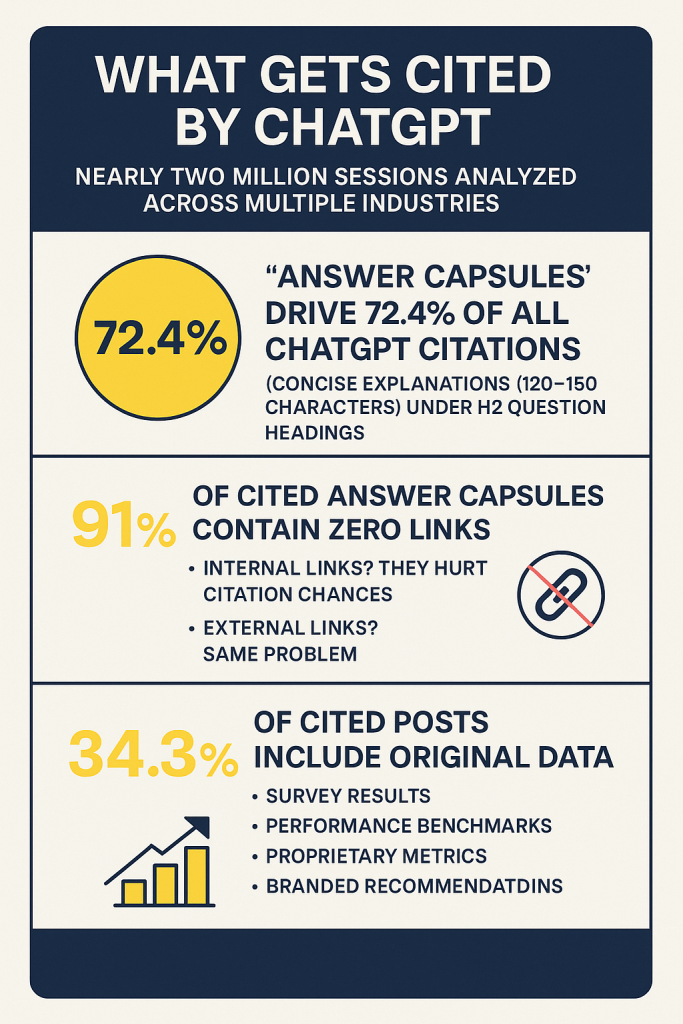
According to the study (published on Search Engine Land), 72.4% of all ChatGPT citations come from content that includes an “answer capsule.”
What’s an answer capsule?
Think of it as a mini-snippet you control:
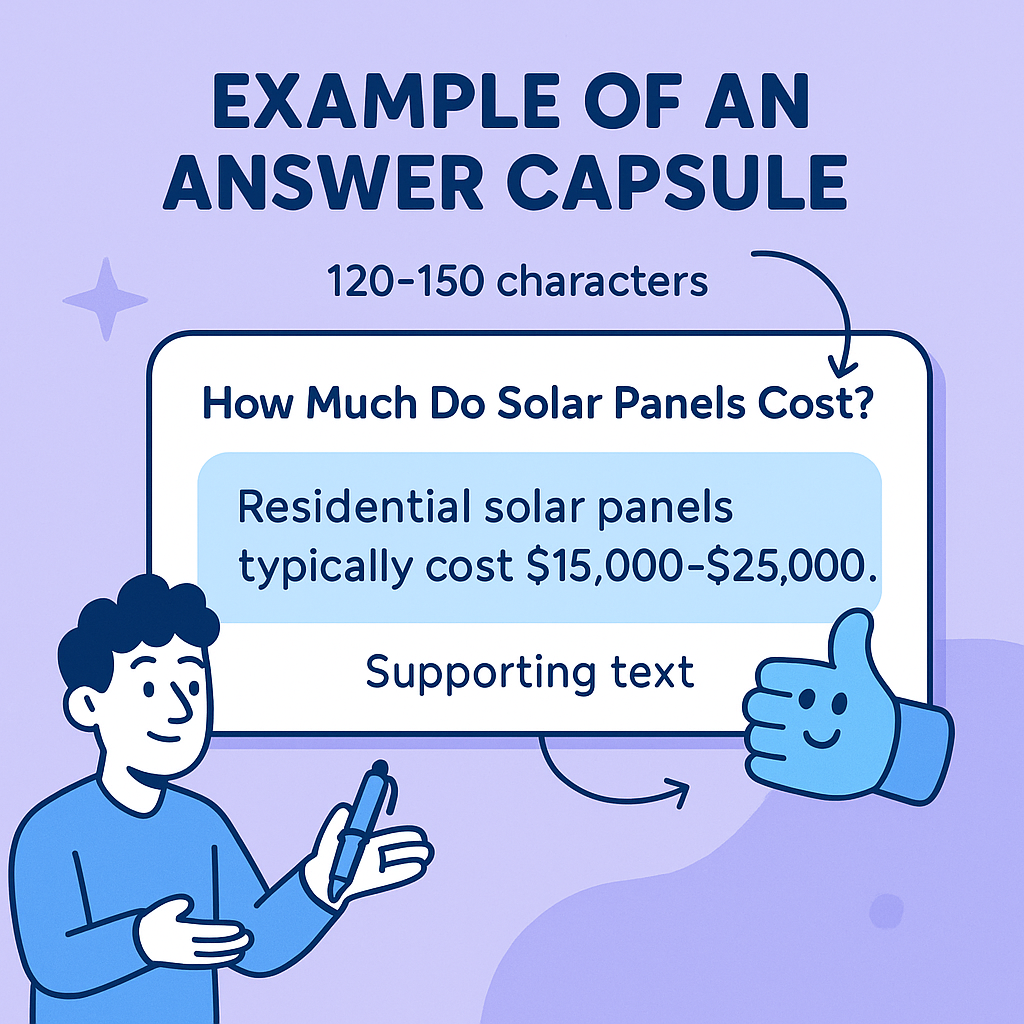
- 120–150 characters
- No fluff
- Directly answers the question
- Placed immediately after an H2-based question
Basically, it’s a self-contained, ultra-clear response — and it acts like a neon sign for LLMs:
“Use this section. This is the answer.”
This is a massive opportunity because traditional SEO often pushes long intros, storytelling, and “value stacking” before giving readers the answer. LLMs have no patience for that. They want the answer first, clean and simple.
The Shocking Twist: 91% of Cited Answer Capsules Contained Zero Links
This surprised even me.
The study showed that internal links and external links inside the answer capsule drastically reduce the chance of ChatGPT citing that section.
Why?
Because links imply:
- The real answer is elsewhere
- This text is not self-contained
- This information depends on external context
LLMs prefer text that can stand alone. A link breaks that flow.
What to do instead:
- Keep the capsule clean — zero links
- Move links to supporting paragraphs
- Don’t interrupt the capsule with brackets, CTAs, or cross-links
This is a simple fix that can instantly make your content more LLM-friendly.
Original Data Supercharges Your Chance of Getting Cited
The study found that 34.3% of cited content included proprietary or original data.
This aligns perfectly with what we see inside ChatGPT trend analysis:
LLMs love:
- First-party data
- Branded metrics
- Survey results
- Industry benchmarks
- Unique analyses
- Insights not found anywhere else
OpenAI and other LLM providers prioritize content that adds something new to the web. If your content merely rephrases what already exists, it becomes less valuable to the model.
Examples of high-value original data:
- “90% of Phoenix homeowners wait too long to replace their AC filter — based on 2,500 service calls compiled by AZ Home Services.”
- “Our agency found that 63% of local service websites improved rankings after removing above-the-fold clutter.”
- “Brainspike Marketing measured a 41% increase in EEAT signals after adding expert quotes into service pages.”
Even one branded statistic can set your content apart.
Why LLMs Gravitate Toward Clean, Capsule-Based Answers
Beyond the study, here’s what we know from LLM architecture and behavior:
1. LLMs extract sections, not pages
They evaluate discrete blocks of text. Cleanly defined capsules are easier to detect and quote.
2. Shorter text blocks increase retrieval precision
150 characters is the sweet spot for semantic clarity.
3. External links break the internal logic of the text
If the text depends on external sources, the model downgrades it.
4. LLMs look for self-contained value
Answer capsules are like pre-packaged, ready-to-insert responses.
5. Proprietary data increases authority weight
Because LLMs try to avoid regurgitating generic content.
This is why adding a capsule is almost like adding a schema-powered snippet — it’s a structural cue the model recognizes instantly.
How Brainspike Marketing Is Implementing This
Here’s what I (Matt Hammerton) recommend — and what we’re already implementing for clients:
 Add answer capsules after all question-based H2s
Perfect for FAQ-style blog posts, informational guides, and “how much does X cost?” articles.
Remove links from the capsule
Move them to supporting content below.
Add at least one piece of branded or proprietary data per article
Even a single line can boost LLM citation opportunities.
Re-optimize top-performing evergreen content
Especially pieces already ranking for question-based queries.
Build capsule-based SEO templates
This is the new “Featured Snippet Optimization” — but designed for AI.
Example of a High-Quality Answer Capsule
H2: How Much Does Furnace Repair Cost in Gilbert, AZ?
Answer Capsule (120–150 characters):
“Most furnace repairs in Gilbert cost $150–$550 depending on the part, age of the system, and urgency of the call.”
Real-World Case Studies Supporting This Trend
 Case Study 1: Healthline’s Snippet Dominance
Healthline uses clean, link-free mini-summaries under H2s. LLMs cite them constantly because they’re structured like answer capsules (even before we called them that).
Case Study 2: PwC and Deloitte Research Pages
Pages heavy on original data nearly always rank well in AI outputs. Their proprietary statistics act as authority signals to LLMs.
Case Study 3: Local Home Services Blogs
Simple, clean Q&A sections outperform longer SEO-heavy content when fed into LLM retrieval systems. Capsule content gives models exactly what they need to reuse the text verbatim.
What This Means for SEO In 2025 and Beyond
Search isn’t dying — but the way content gets referenced is changing fast.
Your content now needs to:
- Help search engines
- Help humans
- Help AI generate answers
If you’re not optimizing for LLM citation, you’re leaving visibility on the table.
The brands that win the next wave of SEO will be the ones whose content gets quoted the most — not just ranked the highest.
This shift is already happening. The data makes it clear.
If You Want This Implemented on Your Site…
This is the new frontier of SEO, and if you want your business ahead of the curve, Brainspike Marketing can build this into your content strategy right now:
- Capsule-based content optimization
- Proprietary data development
- EEAT and LLM-ready formatting
- AI-aligned content structures
- High-authority industry insights
Just reach out — I’ll personally walk you through how to integrate answer capsules across your site and how to leverage this new research to win more visibility in both search and AI platforms.
]]>Over the last week — especially around November 21, 2025 — my agency, Brainspike Marketing, noticed a sudden and widespread drop in Google reviews across dozens of client listings. After comparing our data to their competitors, it became clear this wasn’t random: nearly every profile we monitor lost reviews, ranging from 5 to nearly 200 reviews overnight.
And we’re not alone.
Businesses across the world have begun reporting large, unexpected drops in review counts. One business owner posted on Google’s support forum that their profile fell from 260 reviews to just 88 overnight — a 66% loss with no explanation. (Source: Google Business Profile Support thread)
So… what is going on?
This article breaks down everything we know so far about the late-November review purge, based on:
- Google’s recent history of bugs and mass removals
- Official statements from Google earlier this year
- Independent data studies
- Community reports
- And my own client data as a long-time SEO professional
Let’s walk through what’s happening — and what you should do next.
A New Wave of Review Disappearing Events (November 2025)
From November 18–23, review counts began dropping again across multiple industries including:
- Home services
- Medical practices
- Restaurants
- Local retail
- Automotive
- Real estate
- Contractors
- And even high-volume service brands
Business owners began reporting these issues across the Google Business Profile Community forum, including the thread where a longtime owner wrote:
“My business review count dropped from 260 to 88. Nothing changed. All reviews were genuine.”
— Business Owner on Google Support Forum
My own clients saw losses that fit the same pattern:
- Minor drops of 3–10 reviews
- Noticeable drops of 20–50 reviews
- Severe drops of 100–200+ reviews
When I compared these drops to their competitors, almost every competing listing also showed losses, which confirmed this wasn’t an isolated incident — it was systemic.
Is Google Deleting Reviews, or Is This Another Bug?
Based on the data, it appears both may be happening at the same time, just like earlier waves in 2024 and 2025.
Possibility #1: Google’s Automated Moderation System Is Removing Reviews
Google’s AI-driven spam filters have grown extremely strict since 2023, especially after regulatory pressure from:
- The FTC’s Fake Review Ban (effective October 2024)
- The CMA’s commitments from Google to reduce fake review manipulation
- Rising lawsuits around review fraud
Google has publicly stated it removed or blocked 170+ million policy-violating reviews in 2023 alone, and that number has continued growing every year.
Many legitimate reviews end up getting flagged because they look “suspicious” to the algorithm, such as:
- Too many 5-star reviews in a short timeframe
- Reviewers who left only 1 lifetime review
- Reviews without comments
- Reviews from the same geographic cluster
- Reviews from new accounts
- Reviews left immediately after a service visit
A massive 5-million-review study (GMBapi, 2024) found that:
- 73% of deleted reviews were 5-stars
- Removal spikes happened in large batches
That pattern matches what we’re seeing again in November 2025.
Possibility #2: A Recurring Review Count Display Bug
In February 2025, Google acknowledged a widespread review display bug, where:
- Reviews still existed, but
- The review count displayed on the listing was incorrect
Google’s official statement (Feb 2025):
“We’re aware of an issue causing Business Profiles to show lower-than-actual review counts due to a display issue. The reviews themselves have not been deleted.”
Google fixed that particular bug, but…
A new similar bug was confirmed in late October 2025 (PiunikaWeb, Google Product Experts on GBP Forum), where:
- Old genuine reviews became hidden
- API counts didn’t match profile counts
- Entire batches disappeared for multiple businesses
Multiple Google Product Experts called it a large-scale issue.
The November drop appears to be the continuation or aftermath of that October glitch, though Google has not yet issued a new formal statement.
Evidence Suggesting This November Loss Is a Systemic Event
Here’s what we know for certain:
Multiple industries are affected
The drops are not isolated to one category — everything from locksmiths to dentists to restaurants reported losses.
Review drops vary widely
Some lost:
- 5–20 reviews
Others lost: - 50–200+ reviews
Competitors lost reviews too
This is one of the strongest indicators that it’s a platform-wide event, not a penalty.
Google’s forum is filling up with new complaints
Threads like the “260 to 88 reviews” report are popping up across the Google Business Profile forum almost daily.
Timing lines up with October’s confirmed glitch
That glitch was not fully resolved, and businesses reported delayed symptoms.
Review content often still exists (in some cases)
Some owners reported:
- Reviews that disappeared from the count
- Still appear when searching the reviewer’s profile
This points strongly toward a display bug — though not all cases have this symptom.
Why Google Is Increasingly Aggressive About Review Removal
Google’s review system has been under fire from:
- Government regulators (FTC, CMA)
- Review fraud lawsuits
- Consumer-right organizations
- False-review scandals on Reddit and TikTok
- “Review farms” in developing countries
To protect itself, Google tightened the filters dramatically.
And when Google tightens filters, two things happen:
1. Fake reviews get removed (good)
Google’s machine learning is now excellent at spotting:
- Template-based reviews
- Incentivized reviews
- Location-mismatched reviews
- Reviews from accounts with suspicious behavior
2. Genuine reviews get caught in the crossfire (bad)
Google’s AI isn’t perfect — and when it removes first and reviews later, legitimate businesses suffer.
Why Your Listing May Have Lost Reviews This Week
Here are the likely causes of the November 21–24 purge:
1. Google is purging ‘suspicious’ review clusters
Even 100% legitimate reviews can get purged if:
- They’re mostly 5-stars
- They come from a narrow geographic radius
- Several reviewers created their accounts recently
- Several reviewers left multiple reviews in one day
- The content is short or generic
2. The October review glitch is still rolling out
Some reviews may be hidden temporarily or miscounted.
3. Google’s moderation bot is over-compensating
After the FTC’s fake review ban took effect, Google appears to be filtering more aggressively.
4. A new unannounced update or bug is unfolding
Google rarely announces review updates — they usually get confirmed only after thousands complain.
We are likely in the early stages of another wave.
How to Check Whether Your Reviews Are Deleted or Just Hidden
Here’s what I recommend (as someone who does this daily for dozens of clients):
Step 1 — Screenshot your current review count
Always capture:
- Total review count
- Average star rating
- Date/time
Step 2 — Compare your current review list to last month’s
If you track reviews manually, pull out your last backup.
Step 3 — Check competitors
If competitors lost reviews the same week → this is a systemic event, not a penalty.
Step 4 — Check reviewer profiles
Search for your customers’ Google profiles:
- If their review still displays → the count is bugged
- If it’s missing → it was removed by moderation
Step 5 — Submit a Google support ticket only if needed
Google will not restore reviews that violate policy.
But if:
- Review count is wrong
- Reviews are visible in the backend but not public
- Reviews vanished during a known bug window
Google may escalate it.
What You Should Not Do Right Now
 Don’t ask customers to repost reviews yet
Reposting reviews during a bug or purge often triggers more removals.
Don’t flood Google Support with multiple tickets
Google may temporarily lock your listing for “spammy” tickets.
Don’t immediately solicit a spike of new reviews
Large review spikes can activate the filter even more.
Don’t assume it’s a penalty
If your competitors dropped too, it is not a penalty.
What You Should Do Next (Action Plan)
1. Document everything
Take screenshots of:
- Current review count
- Missing reviews you can still find
- Any inconsistencies in Maps vs Search
2. Create a review spreadsheet
Track:
- Date
- Reviewer name
- Rating
- Review text
This helps you prove losses later.
3. Diversify your review sources
Google reviews are the most important, but not the only ones:
- Yelp
- BBB
- Nextdoor
- Trustpilot
- Angi
- Industry-specific platforms
4. Respond to every review you currently have
Data from multiple studies shows that reviews with owner responses have a significantly lower deletion rate.
5. Implement slow, steady review acquisition
Avoid sudden spikes. Aim for:
- 2–5 new reviews per week (for small businesses)
- 3–10 per week (for medium service businesses)
6. Stay informed
Google rarely explains these issues, so staying plugged into trusted sources is key:
- Google Business Profile Forum
- Local Search Forum
- Search Engine Land
- Sterling Sky’s updates
- Brainspike Marketing’s SEO insights (your blog)
My Professional Opinion as a 17-Year SEO Expert
Based on everything I’ve seen — clients, competitors, forums, and historical patterns — the November 2025 review losses appear to be:
 50% moderation-based deletions
Google’s algorithm is likely continuing to purge reviews it considers “low-trust.”
50% display glitch
Listings are showing lower counts than the actual number of available reviews — something we saw in February and again in October.
100% widespread
It’s not about your business; it’s a platform-wide issue.
Likely temporary for some listings
Some reviews may reappear as systems catch up — this happened during previous waves.
Likely part of Google’s long-term tightening
Expect more waves of removals throughout 2025–2026 as regulatory pressure increases.
A November 2025 Review Purge or Gltich has definitely happened, and you are not alone. We will get through this together, my fellow business owners and SEOs.
]]>Below, we’ll explore how specific industries are putting AI to work in their day-to-day operations and how it’s reshaping the way small and mid-sized businesses operate.

The AI Revolution in Local Business
Until recently, AI tools were either too expensive or too complex for smaller companies. But that’s changed dramatically. Cloud-based platforms, simple integrations, and specialized niche tools have made it possible for nearly every business — even a one-person operation — to streamline admin tasks using automation and machine learning.
Some of the most common administrative functions now powered by AI include:
- Scheduling and calendar management
- Customer intake and communication
- Document drafting and review
- Lead tracking and CRM updates
- Billing and invoicing
- Follow-up reminders and reputation management
For many local entrepreneurs, this means no more endless paperwork, no more missed calls, and no more late-night data entry.
Let’s look at how this plays out across different industries.
How Injury Lawyers Use AI for Administrative Efficiency
Law firms — particularly those specializing in personal injury — are embracing AI faster than most realize. The administrative side of legal work is notoriously time-consuming: drafting demand letters, compiling client documents, scheduling appointments, and keeping communication logs can take up more hours than actual legal analysis.
That’s where AI is changing everything.

Automating Demand Letters and Documentation
One of the biggest breakthroughs for law firms is AI-driven demand letter generation. Traditionally, these letters — which outline the client’s case, damages, and compensation request — took hours or even days to craft. Now, tools like the best AI demand letter service can create professional, accurate, and data-backed drafts in minutes.
AI demand letter platforms analyze case details, pull relevant legal language, and structure the letter for maximum impact — leaving attorneys to review and personalize rather than start from scratch.
Case Intake and Data Management
AI chatbots and intake assistants are now the first touchpoint for many law firms. They handle client screening, gather details about the accident, injuries, and damages, and even prefill forms for paralegals. This reduces admin costs and shortens client onboarding time dramatically.
Predictive Insights for Settlements
Some firms are using AI to analyze prior settlements and verdict data to estimate potential case values. This helps in negotiations and gives both lawyers and clients more transparency during the process.
Ready to Scale Your Local Business with Smarter Marketing?
At Brainspike Marketing, we help service companies — from injury lawyers to HVAC pros — harness SEO and AI-driven strategies that attract more local customers and automate the busywork.
 Let’s Power Up Your Growth
How HVAC Companies Use AI to Streamline Operations
HVAC companies have dozens of moving parts — from dispatching technicians and managing service calls to billing and warranty tracking. AI is now quietly orchestrating all of that behind the scenes.
AI Scheduling and Route Optimization
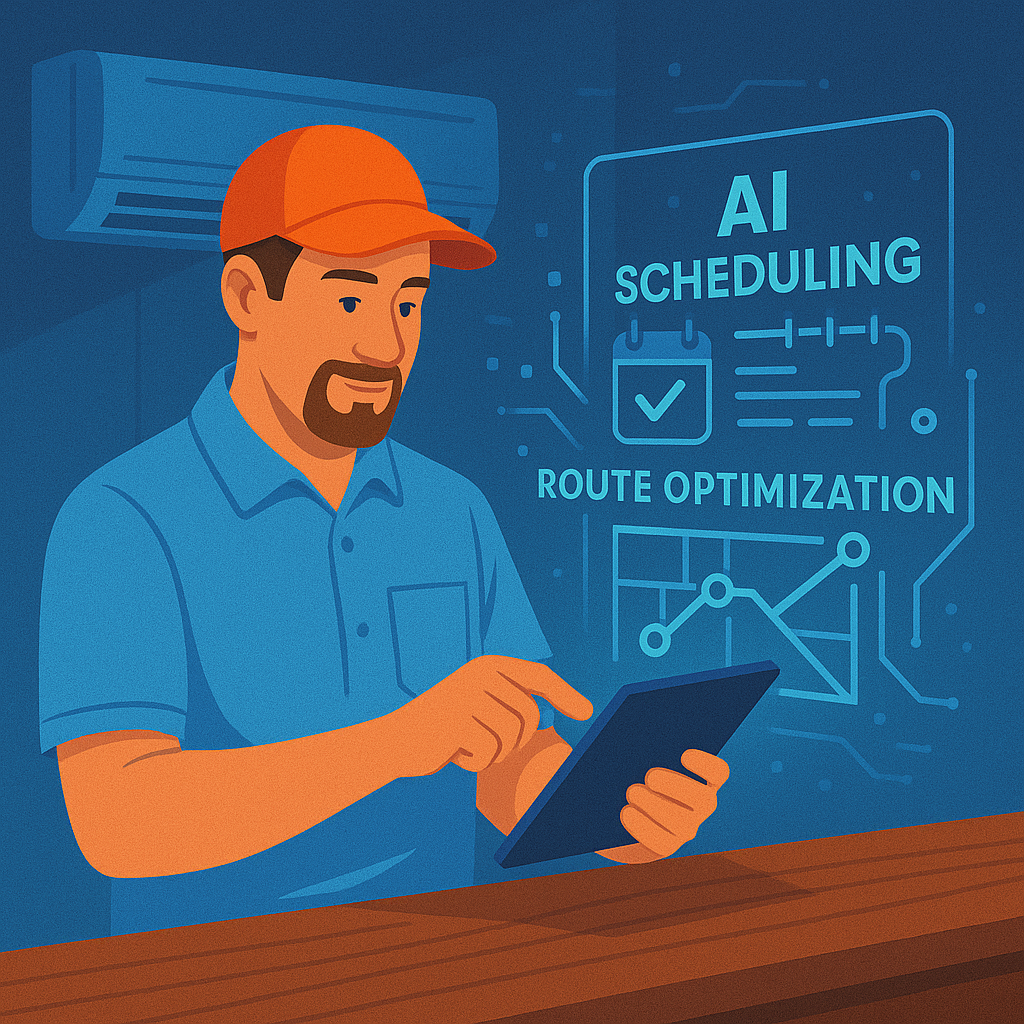
Modern AI scheduling software learns from service patterns, technician availability, and local traffic data to optimize daily routes. This means fewer missed appointments, reduced fuel costs, and faster service response times.
AI-driven tools can even reschedule automatically when a tech runs late or when an emergency repair pops up nearby.
Smart CRM and Lead Follow-up
Many HVAC businesses use AI-enabled CRM systems that track every customer interaction, automatically tag service history, and send out reminders for seasonal tune-ups. Some tools even generate email and SMS campaigns based on past behavior, helping small companies maintain ongoing relationships without a full-time marketing department.
Invoice and Warranty Management
AI document systems now read invoices, match serial numbers, and log warranty information automatically — removing hours of manual entry and reducing errors.
How Garage Door Repair Companies Use AI Every Day
Garage door repair and installation companies are another example of trades leveraging AI quietly but effectively.
AI for Dispatching and Inventory
AI-powered dispatch systems predict demand patterns and automatically assign jobs based on technician skill, location, and time of day. If a customer requests service online, the system instantly checks availability, assigns the nearest tech, and sends automated ETA updates — all without human input.
Inventory tools powered by AI can also track which parts are running low, automatically reorder stock, and forecast what parts will be needed most during certain seasons.
Estimating and Customer Service
When a customer sends photos of a damaged garage door, AI vision tools can now identify the issue, estimate parts and labor, and generate a quote in seconds.
For administrative staff, this removes one of the biggest bottlenecks in the repair process — pricing and quoting.
Locksmith Companies and AI-Driven Admin Efficiency
Locksmiths often handle dozens of small service calls each day — from lockouts to key replacements to security system installations. Each job requires logging, invoicing, and tracking, which used to take hours per week. AI now handles much of it automatically.

Job Scheduling and Lead Routing
AI scheduling tools automatically dispatch locksmiths based on urgency, proximity, and service type. For mobile locksmiths, this means fewer back-and-forth calls with dispatch and more time unlocking doors.
Voice and Chat Assistants
Many locksmith websites now feature AI chat assistants capable of fielding customer inquiries, gathering details about the issue, and booking appointments in real-time.
Voice assistants integrated with mobile apps also record job notes automatically, transcribe them, and attach them to invoices — replacing manual note-taking.
Smart Invoicing and Payment Collection
AI systems generate digital invoices the moment a job closes, automatically calculating mileage, service fees, and taxes. Payment links are sent instantly, cutting collection times dramatically.
The Broader Impact: AI as the Local Business Backbone
AI has gone from “nice-to-have” to “absolutely essential.” Local businesses that adopt it early are finding they can operate leaner, faster, and more accurately than competitors. For many, it’s not just about saving money — it’s about survival.
Here are some overarching benefits being reported across industries:
- 50–70% time reduction in administrative paperwork
- Improved customer response times due to automated communication
- Fewer human errors in billing, scheduling, and data entry
- Stronger online reputations through automated follow-up and review management
- Better decision-making from real-time analytics
AI tools are now the invisible assistants running local economies — allowing small businesses to operate with the sophistication of large enterprises.
The Future: Smarter, Simpler, and Even More Personalized
In the next few years, expect even deeper integration between AI and local business operations. The next generation of systems will combine AI scheduling, voice automation, CRM, and marketing into one unified dashboard.
Imagine this: a customer books an HVAC repair through a chatbot, the AI system schedules it, generates an invoice, updates the CRM, and sends a post-job review request — all automatically. That’s not a fantasy. It’s already happening for forward-thinking local businesses today.
AI is everywhere, and Local Business Is No Different!
Whether it’s drafting legal documents, routing a technician, or generating an invoice, AI has become the silent co-worker in nearly every modern business. Local companies that learn to embrace these tools aren’t just saving time — they’re building the foundation for smarter, more scalable growth.
The age of AI-driven local business has arrived — and it’s only getting started.
]]>Artificial intelligence now drives how homeowners discover plumbers, HVAC techs, electricians, and every other home service imaginable.
If you’re still relying on traditional SEO tactics — keyword repetition, directory listings, or cookie-cutter blog posts — you’re already behind.
AI SEO is about trust, clarity, and experience. It rewards businesses that create content people genuinely find helpful, and that AI systems can clearly understand.
At Brainspike Marketing, we help home service brands transform their online visibility by optimizing for how search engines and AI assistants now think.
Below is a complete breakdown of what that means, how to execute it, and how strategies differ for every industry.
1. What AI SEO Actually Is (and Why It Matters Now)
AI SEO means optimizing your business for AI-generated results — the ones users see in Google’s AI Overviews, ChatGPT responses, and voice assistant answers.
When someone asks:
“Who’s the best emergency plumber near me?”
“How much does AC repair cost in Scottsdale?”
“Why won’t my garage door close?”
AI systems pull their answers from a small pool of trusted, well-structured, and contextually relevant websites.
Your goal: become the trusted source AI quotes.
To do that, your site must:
- Build topical authority — cover every angle of your services.
- Use local context — landmarks, zip codes, and neighborhood names.
- Implement structured data — Schema markup for clarity.
- Maintain credibility signals — consistent info across every platform.
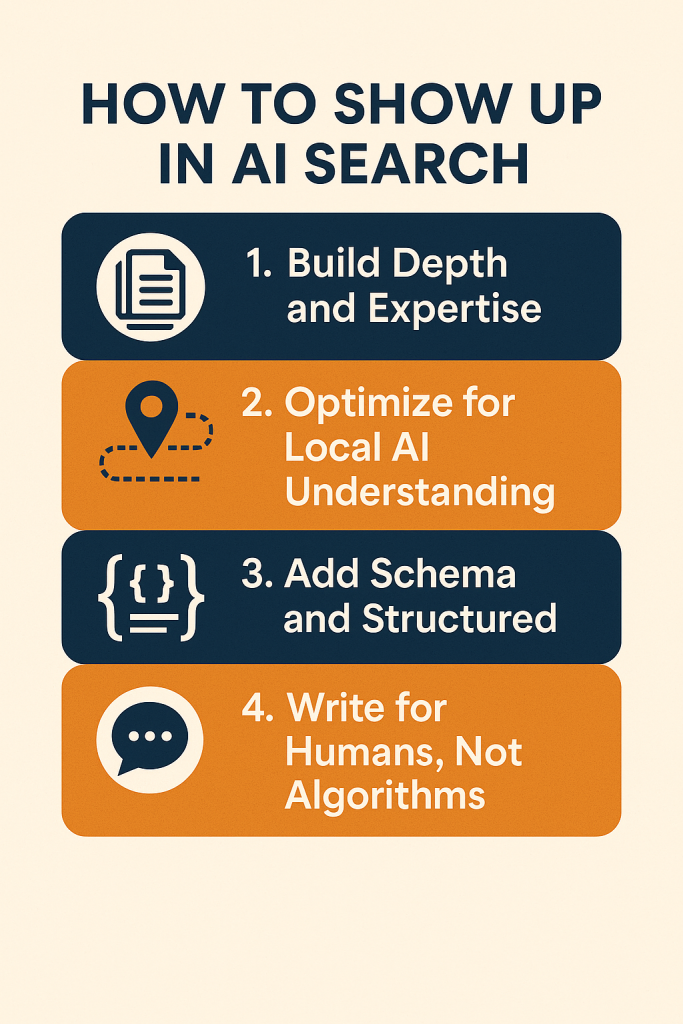
2. The Blueprint: How to Show Up in AI Search
Step 1: Build Depth and Expertise
AI algorithms want experts, not generalists.
That means going beyond one “plumbing” or “AC repair” page and creating a cluster of supporting content that covers all questions customers ask.
Example:
- Main Page: AC Repair in Chandler, AZ
- Support Pages:
- Why is my AC not cooling?
- Signs your compressor is failing
- How much does Freon replacement cost?
- When to replace vs repair your AC
When your site covers a full topic from every angle, AI recognizes your business as the definitive local authority.
Step 2: Optimize for Local AI Understanding
Home service searches are inherently local. AI engines must recognize your service areas precisely.
Brainspike’s Local AI SEO Checklist:
- Consistent NAP (Name, Address, Phone) across all platforms.
- Embed Google Maps and “Areas Served” schema.
- Use conversational local language: “Gilbert homeowners,” “Scottsdale neighborhoods,” etc.
- Include FAQs in natural Q&A form.
AI systems interpret conversational questions like:
“Who installs garage doors near Tempe Marketplace?”
better than generic service lists.
Step 3: Add Schema and Structured Data
Structured data is what AI reads when deciding whose site to feature in a voice or AI answer.
Home service businesses should include:
- LocalBusiness Schema: Address, hours, and service area.
- Service Schema: For each major offering.
- Review Schema: For displaying customer testimonials.
- FAQPage Schema: For common service questions.
Brainspike integrates this directly into your site code so AI models clearly “see” what your business does — and where.
Step 4: Write for Humans, Not Algorithms
The most common SEO mistake in 2025? Over-optimization.
AI systems can detect robotic phrasing instantly.
Instead, write conversationally, like a pro explaining something to a customer.
Example:
Old: “We provide expert plumbing services in Gilbert, Arizona.”
AI-Optimized: “If your water heater starts making banging noises in Gilbert, here’s what’s probably happening — and how to fix it.”
Brainspike’s content strategy team crafts service pages and blogs that sound natural, local, and helpful — which is exactly what AI prefers.
Step 5: Stay Consistent Across the Web
AI systems don’t just scan your website. They analyze:
- Google Business Profiles
- Yelp listings
- Facebook pages
- BBB entries
- Local directories
If your hours, service areas, or name differ across these, your trust score drops.
Brainspike performs full citation audits and corrections quarterly to maintain perfect consistency across every platform.
3. AI SEO by Industry: How Each Approach Differs
Every home service industry has its own search behavior patterns and ranking signals. Here’s how Brainspike tailors strategies by niche:
Plumbing SEO
- Prioritize voice search optimization for urgent intent: “plumber open now.”
- Include real job photos and transparent pricing signals.
- Publish repair guides, not generic service blurbs.
- Add local emergency-related content (“burst pipe repair near Mesa”).
AI Key: Authenticity. Real technicians, real work, real addresses.
HVAC & Air Conditioning SEO
- Build seasonal campaigns (AC repair in spring, furnace repair in fall).
- Use brand-specific content (Trane, Goodman, Carrier).
- Create energy-efficiency guides tied to local climate data.
- Add city mentions in headings: “Best AC Tune-Ups in Phoenix, AZ.”
AI Key: Relevance. AI loves up-to-date, weather-tied HVAC content.
Locksmith SEO
- Include license numbers and visible credentials.
- Write educational pieces on key types, access systems, and push bars.
- Add 24-hour schema markup for emergency searches.
AI Key: Trust. Locksmiths with verified details and transparency dominate AI results.
Garage Door SEO
- Create brand pages (LiftMaster, Genie, Chamberlain).
- Add photo-heavy repair blogs and step-by-step visual guides.
- Include structured product data for every opener and spring type.
AI Key: Completeness. AI prefers brands that appear knowledgeable about specific models.
Roofing & Remodeling SEO
- Add detailed project pages with before/after images and drone shots.
- Mention local events (“monsoon damage roof replacements in Peoria”).
- Publish educational resources on materials and warranties.
AI Key: Recency + visuals. AI favors recent, verifiable project content.
4. The Brainspike AI SEO Framework
| Component | Purpose | How We Implement It |
|---|---|---|
| Topical Authority | Build full service coverage | Deep keyword mapping and content silos |
| Local Relevance | Connect to neighborhoods & landmarks | City pages, schema, and area copywriting |
| Schema Integration | Improve AI understanding | Structured markup for services and reviews |
| EEAT Compliance | Boost trust and credibility | Real author bios, certifications, and client proof |
| Conversion Focus | Turn traffic into leads | Strategic calls-to-action and mobile UX audits |
5. Expanding Beyond the Website
AI SEO extends across your entire online ecosystem. Brainspike ensures:
- Weekly Google Business updates (Google indexes these for AI results).
- Regular content refresh cycles.
- High-quality backlink acquisition from local sources.
- Social and YouTube integration for video snippets AI can crawl.
AI doesn’t see isolated pages — it sees signals from everywhere your business exists online.
6. The Future of Home Service SEO
AI is shifting search away from simple rankings toward answer-based visibility.
Instead of “ranking for keywords,” you’ll need to become the answer itself — the most complete, helpful, and verifiable resource available.
At Brainspike, we help home service companies become that answer — not through shortcuts, but through intelligent, data-driven, AI-ready SEO strategies.
Ready to Future-Proof Your Home Service Business?
AI SEO isn’t about chasing algorithms — it’s about becoming the business algorithms trust.
Whether you’re a plumber in Gilbert, HVAC pro in Scottsdale, or garage door company in Columbus, Brainspike Marketing can help you build an online presence that AI search engines recognize and recommend.
→ Let’s talk strategy.
We’ll show you exactly how to turn AI SEO into leads, calls, and booked jobs — fast.